Showing posts with label Asian Culture. Show all posts

Monday, March 20, 2017

I Made My Own Acupuncture Needle!

For many years now, I had the idea that I would make my own acupuncture needle out of a meteorite.  In ancient times, before the technology of smelting had been discovered, meteorites were one of the only sources of high-purity iron that, through firing and pounding, could be made into steel.  In ancient China, swords that were forged out of meteorite iron were considered to be not just functionally exceptional - harder, sharper, less apt to break in combat - but endowed with celestial powers as well.  It is hard to believe that acupuncture needles, associated from the very beginning with stars and the cosmos, would not have been made from meteorites.  The acupuncture points on the human body were regarded as a microcosm of the stars in the heavens.  What better instrument to illuminate our corporeal stars than a sliver of condensed heavenly yang qi?

Meteorite chunk
Last year I turned fifty, and as part of the year-long celebration, went on a camping trip with my old friend Andy McKenzie.  I drove from Santa Cruz and he drove from Fort Worth, Texas, and we met up at Zion National Park in Utah. On a day trip to Bryce Canyon, we pulled into one of the many rock and mineral stores that dot the Southwest.  Inside, I found small chunks of meteorite on sale, and thought, "Aha! Finally, the raw material for my needle!" and bought a couple.


The Micro-Forge

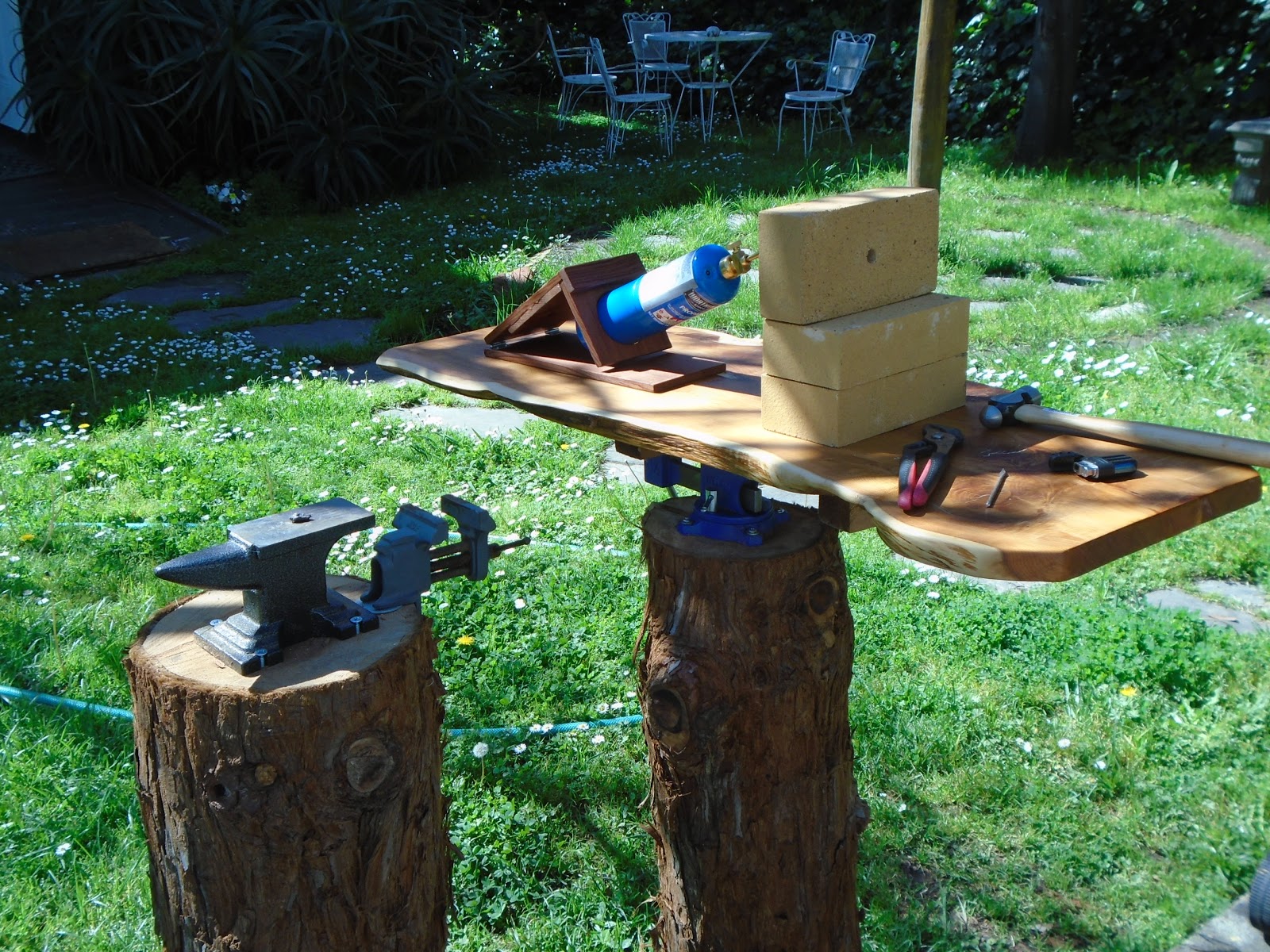
Over the course of the year, I designed and built a little outdoor workshop and smithy where I could try to transform my meteorite into a needle.  I figured that, since everything was on such a small scale, I could make a forge out of a blow torch and a fire brick or two.  All that was left to do was to actually make the needle!  So, the other day, I took advantage of the break in rain and got to work.

It took a day of firing and pounding, and another day of straightening and polishing, heat-treating and oil-quenching, and now I have my very own hand-made meteorite needle!

Slowly taking shape
NOTE: you may be thinking, that needle looks awfully fat to be sticking into people!  Well, this type of needle, called teishin in Japanese, is not meant for insertion.  It functions as a detector and modulator of qi, and achieves its effects by touching the skin rather than piercing it.  This is the style of acupuncture that I practice, as taught by my teacher Anryu Iwashina ("Dr. Bear").


TECHNICAL CONSIDERATIONS:
Final version, with manzanita carrying case.
Composition: This needle is made from a fragment of the Campo del Cielo meteorite that landed in Argentina between 4,000 and 5,000 years ago, and is 93% iron, 6% nickel, with trace amounts of cobalt, iridium, gallium, and germanium.  The cobalt is responsible for the bluing oxidation that occurs at around 900 degrees C; you can see a hint of it on the thicker end of the needle, where I left a cerulean sheen as a reminder of the needle's heavenly origins.

Dimensions: At 2 grams and 6.7 centimeters, my needle is a little lighter and shorter than my gold and silver teishin.  It handles very nicely and gets an instant qi sensation when touched to the skin.

Polarity: Acupuncturists who use teishin may wonder how I determined which end should be the pokey sedating end and which the rounded tonifying end. Unlike the gold and silver of the traditional teishin pair, iron, nickel, and cobalt are all strongly ferromagnetic. These metals lose their magnetism at high heat (called the Curie temperature; about 770 degrees C for iron) and then remagnetize as they cool if they are subjected to an external magnetic field. Since I was heating and cooling the needle in the earth's magnetic field, I made a point of aligning the needle as it cooled on a north-south axis so that the rounded end faces north and is thus  more tonifying. Please note there is some controversy about what the poles of a magnet do, therapeutically speaking, and even about how they are named.  Because I admire his experimental and clinical approach, I am adopting Yoshio Manaka's method and deem the north-facing end (+) to be tonifying.  Personally, I think that needling technique is the more important determinant of what happens in a patient's body during a treatment.  I am not a practitioner of magnet therapy per se, but figured that since my needle will be magnetic by nature, its polarity should be theoretically consistent with the use of magnets in acupuncture.

Friday, August 22, 2014

Everything is the Ass

There are only two diseases:
One is riding an ass to search for the ass;
The other is riding an ass and being unwilling to dismount.

You say that riding an ass to search for the ass is silly
and that he who does it should be punished.
This is a very serious disease.

But, I tell you, do not search for the ass at all.
The intelligent man, understanding my meaning,
stops searching for the ass,
and thus the deluded state of his mind ceases to exist.

But if, having found the ass, one is unwilling to dismount,
this disease is most difficult to cure.

I say to you, do not ride the ass at all.
You yourself are the ass.
Everything is the ass.
Why do you ride on it?
If you ride, you cannot cure your disease.

But if you do not ride,
the universe is as a great expanse open to your view.

       - Shu Chou, quoted in Fung Yu-Lan, A Short History of Chinese Philosophy

Wednesday, July 17, 2013

How to Make We Qi Fermented Pickles


A fun thing to do in the summer is to make your own fermented pickles.  These are the directions we attach whenever we give away a jar.

To give credit where credit is due, We Qi is very much like the Korean national pickle known as kimchi.  But We Qi (pronounced “Wee Chee”) is a process, not a product!  Most importantly, you shouldn’t make it all by yourself.  Make it with your partner, with family, with friends, and your Qi (“breath” or “energy”) will alchemically merge with the Qi of the ingredients, and create a remarkable living food: We Qi. 

Make some, eat some, give some away!  Join the We Qi Revolution!

Ingredients:

            2 medium to large heads nappa cabbage
            2 daikon, peeled and cubed
            ½ cup sea salt
            5 - 10 cloves garlic
            10 green onions
            powdered red pepper or chopped fresh red peppers (adjust to your desired level of heat)
            juice from previous batch of We Qi (optional)
            2 large buckets
            plate
            big rock

Procedure:

  1. Set aside several large outer leaves of cabbage
  2. Chop up rest of cabbage, coarsely, and divide into two buckets for easy mixing
  3. Add half the salt to each bucket, mix well by hand
  4. If you have juice from your previous batch of We Qi, add it to the mix to hasten fermentation
  5. Combine into one bucket
  6. Cover with large whole cabbage leaves
  7. Place upside-down plate over the top
  8. Place large clean rock on top of plate
  9. Cover bucket with moist cloth, bungee-cord it closed so critters can’t get in
  10. Set aside in a cool place for three days, mixing occasionally
  11. Add crushed fresh garlic, coarsely chopped green onions, red pepper, daikon cubes
  12. Cover with moist cloth and set aside another three days – let it get good and bubbly
  13. Transfer to clean jars and keep in refrigerator until ready to enjoy
  14. Adjust for over-saltiness (if necessary) by adding more daikon; adjust for under-saltiness by adding salt
  15. Give away some jars along with these directions so that others can experience the Way of We Qi!

Variations:

Add other vegetables, like carrots, kale, turnips, radish, etc., or other interesting things like kombu seaweed slices or watercress

Add fresh herbs like ashitaba leaves or gotu kola and let them ferment along with the cabbage.

If you are the adventurous type, add anchovy paste, fish stomachs, or other funky matter.

Instead of starting anew each time, just keep adding fresh vegetables, sea salt, garlic to your bucket of We Qi.

Om We Qi Yum!

Thursday, September 01, 2011

Kiraku: Health and the Take-It-Easy Attitude

Kiraku-An, the "Take-It-Easy Hut"
When people ask me what I consider to be the single most important factor in maintaining health and dealing with disease, my response is simple: Attitude. On the one hand, this may be so self-evident as to not be worth saying (OF COURSE the better your attitude, the better you can handle life and everything it throws your way). On the other hand, it may sound like I’m blaming the victim (“if only your attitude were better you wouldn’t have gotten your illness in the first place”). So I’d like to take a few minutes to explain what I mean.

The fundamental core belief of traditional Chinese medicine is that in health there is flow, and in illness there is a blockage of flow. This “flow” refers to the flow of qi and blood in the body. By feeling the pulse, palpating the musculature, looking at the tongue, and asking a lot of questions, the acupuncturist diagnoses where the flow of qi and blood is blocked, and applies needles to help restore proper flow. This is why patients almost always feel better after an acupuncture session: they are nudged back towards balance, they experience less pain and discomfort, their overall sense of wellbeing increases. This unblocking and rebalancing allows the body to rise to the occasion and apply its own innate healing force to confront whatever health challenge it faces.
What are the things that can impede flow in the body? Traumatic injury certainly can, as can exposure to environmental toxins. Unhealthy foods “gunk up” the system, as do drugs and alcohol. Various diseases cause their own particular stagnations in the channels and organs. But life itself can create stagnation. Stress, worry, chaos are some of the biggest contributors. Stress causes the qi to stagnate, and over time, if the stress doesn’t let up, this qi stagnation goes deeper and turns into blood stasis, turning less energetic and more material. Eventually the blockage can manifest as a physical accumulation – a cyst or lump, or in the worst case a cancerous tumor.

There is certainly a random element in illness; you can do all the right things and still get sick. Nevertheless, it behooves us to do everything in our power to stay well or get well: eat healthy foods, avoid bad fats, exercise regularly, sleep enough, have loving relationships, a supportive community, and a rich spiritual life. But the single most important factor is your attitude, since without the positive attitude you wouldn’t do those other things in the first place!

Another way of looking at it is that the biggest culprit here is modern living. We have to pay our rent or mortgage, we have to put food on the table, we have to raise our children, go grocery shopping, pay the bills, but in order to do all those things we have to work, and that takes up most of our time, leaving precious little time for all the rest. Fitting it all into a 24-hour day and a seven-day week means we get stressed out. Getting sick on top of it all stresses us out even more. What can you do to break the cycle? Not everyone can afford a radical fix, like quitting your job or moving to Tahiti. But what you CAN do, right now, is take a deep breath, let it all the way out, take a break from whatever you’re doing, relax, get some sun on your face and fresh air in your lungs. Sit and enjoy. Maybe chat with a friend, have a glass of wine, share a simple meal. You may not be able to change how the world works, but you can change your attitude towards it.

There is a wonderful Japanese word, kiraku. Kiraku evokes a sense of leisure and enjoyment, of taking it easy and enjoying life. The word is composed of two Chinese characters: the first, ki, is the Japanese pronunciation for qi, energy or breath. The second character, raku, means enjoyment or pleasure. In its ancient form, the pictograph for raku depicts a drum and bells on a stand. So raku (actually its alternate reading, pronounced gaku) also means “music,” as well as the pleasure produced by listening to music. When your ki is raku, when your qi is flowing in a leisurely way through the channels, there is health. I imagine kiraku as the quintessential attitude of the ancient sages, enjoying an unhurried life and appreciating the qi pulsing in their own bodies and in all of nature. The kiraku attitude is the antidote to modern-day craziness. I believe that it is also the best preventative and treatment for all ills. My studio in Santa Cruz is called Kiraku-An, the “Take-It-Easy Hut” or “Qi Appreciation Hermitage*.” Maybe one day you will visit me there and together we will enjoy the music of leisurely qi. But even if not, that’s OK too. Because the beauty of kiraku is that it doesn’t require a doctor, or fancy equipment, or any money: it starts right now, right where you are, with you.


*An, “hermitage,” is an interesting character, consisting of a radical denoting a dwelling, plus a phonetic component consisting of a character meaning something like “to cover.” But a further breakdown of this component yields the image of a man, and below it the ancient Chinese character shen, originally derived from the image of two hands extending a rope, and therefore the idea of extension or expansion. And, indeed, a hermitage is a dwelling where a man sits in contemplation until he feels a sense of expansion. I prefer an alternate version of the an character, and a different interpretation: the dwelling radical is replaced with the grass radical, giving the image of a rustic thatched hut. And the character shen has long been associated in Chinese cosmology with the ninth of the twelve Earthly Branches, symbolized in the popular Chinese “zodiac” as the Monkey. So the hermitage (or at least my hermitage) is a place where a person (the human figure with arms and legs akimbo, in the middle) can ingest medicinal herbs (the grass radical on top) and enjoy the easy-going life of a monkey (the shen character, on the bottom, with its tail curving out towards the right). Or, if you prefer, the hermitage is a hut where a monkey sits down, and, expanding his consciousness, becomes a man.

Saturday, May 05, 2007

The Dew of Immortality


Today is May 5th, my son Lukas' birthday, the ancient Celtic fire festival Beltane (give or take a day or two), Cinco de Mayo, and the Japanese festival known as Boys' Day. Although it has since morphed into a more inclusive "Children's Day", all Japanese know that the festival always was and actually still is Boys' Day (girls have their own Girls' Day on March 3). The quintessential symbol of Boys' Day is the koinobori, large carp-shaped streamers that fill with wind and swim in the air from long bamboo poles. We fly our koinobori every May, and I love how it soars through the air, and I love this celebration of my son's life and good health. The Japanese revere the carp as a symbol of strength and determination, because it fights through obstacles with great spirit, swimming upstream, even scaling waterfalls, to get to where it's going. Some time ago my parents sent me a beautiful little silk painting, of a boy hanging onto the back of a big koinobori. And I thought, all of us boys ride on the back of a monster fish. The fish takes us up and down and all over the place, and we hang on because it is one exhilarating ride - truly the ride of our lives, and in some Darwinian sense the reason for our lives. This fish, of course, is our sexuality.

This essay explores the sex drive from a male, East Asian, alchemical/religious perspective. I vacillate between thinking there's something to it and thinking it's delusional nonsense. I like the idea that we can recognize the tremendous energy of our sexuality and put it to spiritual use. But I have this deep suspicion that most people are better off just enjoying sex as sex, rather than trying to control it for supposedly spiritual ends. Anyway, here it is. Happy Boys' Day!

-------

There is a curious notion, prevalent among certain sections of the alternative medicine and New Age subcultures, that one can improve health and possibly even attain states of spiritual perfection, by recycling one’s sperm. There are many ways to do this. You can be celibate, thereby limiting the number of emissions to those few nighttime incidents that are beyond your control. Or, you can have sex, but refrain from ejaculating through the use of certain tricks of sphincter control and qi redirection. Finally, when all else fails, you can push with your finger on the so-called “Million Dollar Point” located between the anus and the scrotum, to block the escape of semen and reabsorb it in your body.

The origins of this practice are lost in the mists of prehistory, but they almost certainly have to do with ancient man’s realization that sperm holds within it an awesome power – the power to co-create life. What if this power could be harnessed for self-cultivation? This is the origin of celibacy in most Asian religious traditions: a focusing inward of life’s energies, rather than the outward focus of the householder or “man of the world.” Many religious sects rejected sex because it represented attachment to the body and the world, the misdirection of life force into karmic entanglements and away from enlightenment. But a few schools, most notably some South Asian tantric traditions and certain Daoist sects in China, figured out how to have it both ways. They opted to utilize the energies generated by sexual activity, and incorporated non-ejaculatory sex into their rituals. Central to the doctrines of these schools is the importance of what the Chinese have termed jing: the primal “substance” variously translated as “essence,” “sperm,” and “sexual energy.”

In China, what was originally a religious practice became somewhat secularized into what we now call “internal alchemy.” In contrast to the earlier external alchemists, who attempted to create an elixir of immortality out of various minerals and herbs, the internal alchemists believed the elixir was to be created within the body, using many different psycho-spiritual techniques. The goal of the alchemist was to take the awesome life-creating power of jing, transform it into the life-serving vitality of qi (life energy), then finally transmute the qi to arrive at the elixir: a refined force of spiritual potency that circulated through the meridians and conferred health and longevity. Some alchemists insisted that the creation of elixir was a purely internal solo process; others believed the dew of immortality was to be found in the merging of yin and yang that occurred during sex. Whether pro-sex or anti-sex, the alchemists all agreed that the conservation of jing was of paramount importance.

What is interesting to me is that these ideas have become so popular now, in the West. In a culture that regards ejaculation as a healthy “clearing of the pipes,” the popularity of sperm retention seems unlikely. But then again, maybe it’s not so strange that our sex-obsessed society has latched onto this particular aspect of Asian culture.

One man is largely responsible for the current popularity of sperm retention. He is Mantak Chia, a self-proclaimed Daoist master from Thailand who runs workshops and has written a whole slew of how-to books on this topic. Chia has managed to cash in on people’s longing for transcendence, as well as their interest in sex. He teaches basic qigong techniques that are central to all Chinese meditation schools and internal martial arts, but I suspect that his popularity is due primarily to the sexual angle of his instruction. He teaches couples ways of squeezing their muscles and clenching their teeth during sex to re-direct their orgasms inward and upward. For practice prior to attempting the real thing, and as a form of self-cultivation in its own right, Chia teaches methods of self-stimulation combined with breathing and visualization: you might call this "transcendental masturbation". Chia has single-handedly made internal alchemy into a booming business.

In case I sound overly critical, let me point out that I am a firm believer in Chinese methods of meditation and self-cultivation. As an acupuncturist, I teach patients qigong techniques to quiet the mind and circulate the qi. But to me, sperm conservation has the ring of neurosis. I believe that sperm retention thinking is part of a broader cultural pattern prevalent in patriarchal Asia, a pattern that fears female sexual vampirism (and female sexuality generally, since women can have all the sex they want without losing jing) and reacts to this fear by hoarding sperm. This pattern appears in folk tales about fox-women preying on young scholars; it shows up in the large number of acupuncture points and herbal formulas designed to treat spermatorrhea (“sperm leakage”); one could even argue that China’s huge Three Gorges Dam is its national jing obsession writ large.

The main reason I object to the currently popular methods of sperm retention is that they exhibit an extremism that runs counter to the generally middle-of-the-road common sense of traditional Chinese medicine. Suppression of a natural outward energy just seems like it would lead to qi stagnation and possibly even medical problems (in fact, I know of several cases of “blue balls” and benign prostate hyperplasia among would-be internal alchemists; one needed a year of acupuncture with a senior Chinese acupuncturist to undo the energy blockage created after attending one workshop). There is a popular saying in Chinese, “xing ming shuang xiu,” which is commonly translated as something like “A sound mind in a sound body.” What it literally means is the dual cultivation (shuang xiu) of self-nature (xing) and life energies (ming). This saying, which lies at the root of all Chinese methods of health improvement and self-cultivation, reminds us that personal conduct and moral bearing, which have to do with xing, are just as important as the development of the life energies that comprise ming. I believe that the commercialization of qigong and related practices in this country has led to an unhealthy overemphasis on the latter, with a concomitant surge in the popularity of the more unusual, and especially sexual, aspects of Asian health culture.

My goal is not to malign practitioners or instructors of qigong and other Chinese health disciplines. Instead, I caution against dangerous literalism of any sort. I resist the idea that the dew of immortality is any one thing. Our jing, the innermost and deepest source of our creativity, is the energy of the universe transforming matter, spreading over the surface of our planet as desire, as streams of lovers, children, descendants, nucleotides, alkaloids, neurotransmitters, brainwaves, photons, memories, music, stories, words, artifacts coarse and fine, a mystery spreading like a plague through these strange, pulsing, living, mortal things that we are. The elixir bubbles forth through all of creation, shimmering and radiant, if only we are present enough to appreciate it.

Thursday, June 08, 2006

Into the Yang

As we head into the summer, it’s hard to feel separate from the explosion of life around us. Green leaves soaking up sunshine, flowers blooming everywhere, spewing their genetic matter out into the atmosphere to ensure that there is a next generation of flowers (and that many of us get sneezy, wheezy, and itchy-eyed). We too get that surge of life, love, lust, call it what you will – it’s the yang rising in us as in the rest of nature.

When I was a child growing up in Japan, we celebrated the coming yang by going outdoors on the last night of winter and throwing handfuls of hard little soybeans out towards the street while shouting, “Oni wa soto! Fuku wa uchi!,” meaning something like “Devils OUT! Blessings IN!” Some years the neighborhood men would dress up like ogres and we would pelt them with soybeans, giddy with the feeling that with our violence we were somehow assisting the transition to sun and light.

As we approach the peak of summer, the yang energy grows daily, bathing us in more and more sunlight and heat. While Asian folk traditions equate yang with blessings and yin with devils, Chinese medicine characteristically preaches balance over absolutism. Yang energy has a tendency to flow upward and outward (witness the flowers and their pollen), and although it is fine to enjoy the yang coursing through our bodies, it is wise not to overdo it. Upward and outward pushed to the extreme can, in the human body, translate into having a stroke or throwing up. Too much activity during the hot months can consume our yin and literally “burn us out.” Since there is a natural preponderance of heat, it is healthy to balance it with cooling foods like cucumber, mung bean soup, and watercress. This is especially true for people who suffer from “hot” conditions like acne or rheumatoid arthritis. Children, who tend to be quite yang to begin with, may become susceptible to fevers and diarrhea. To prevent these and other summertime health problems, they should be fed a bland diet with an occasional cooling treat like fresh sugarcane juice or a few slices of watermelon. Overall, for everybody, moderation is the key to good health.

That said, summer is the time of excess. I feel like it’s been one long party since it finally stoped raining: birthdays, graduations, barbecues, concerts, a wedding. And, of course, there are more parties to come: Summer Solstice, Fourth of July, all those summer birthdays. Are the fun times ever going to end?

Seasonally speaking, the fun times do end. Which, for most of the world, is all the more reason to party all summer long, and into the fall harvest. When winter comes, it is the time to rest, to conserve our strength and nibble on the nuts, grain, preserves, and dried fruit we have saved (which is why the heavily commercialized stress-drenched modern Christmas, going counter-current to the natural seasonal energy, leaves us drained). Then, as the days start to get longer again, we celebrate the coming spring and look forward once again to the rising yang.

Yin to yang, yang to yin, the seasons provide the background and energetic charge to everything else in our lives. No wonder that an appreciation of seasonal changes underlies every celebration of every cultural tradition in the world: the seasons come before religion, came before there were human beings. Our planet was formed of the same hot stuff as the sun. As it cooled, a crust formed. On that very thin layer between the coldness of space and the warmth of our planet’s molten core, an even thinner layer of life – the biosphere – emerged. We, and all of life with us, evolved in the ever-shifting play between yin and yang, between the vastness of space and the womb of the earth, between the fire of sun and the water of ocean, between the cold of winter and the heat of summer. Of course we celebrate the seasons; they are the crucible from which we emerged.

But, of all the seasons, summer is special. During the last Ice Ages, we survived a hundred thousand years with no summer. Imagine our ancestors, emerging from their caves that first warm day after countless generations of cold, warming their bones in the sunlight, watching the first green plants poke out of the melting snow. Having lost summer once, we do our best to capture it when it comes around: in pickled peppers and home-canned tomatoes, in memories of summer romances, days at the beach, favorite vacations and camping trips. On Double-Five Day (the fifth day of the fifth lunar month, which usually falls in June), my children and I collect mugwort leaves in the mountains, capturing their yang essence to burn in the winter as moxa to strengthen my patients’ immunity and ward off colds.

We will always yearn for the pure yang at the beginning of time, a dim memory of the cosmos prior to life, prior to matter, burning inexorably through all of our cells. In the summertime we come as close as we’ll get to the to the great yang mystery of life and light, and we celebrate it. Happy Summer! May the devils stay out and the blessings keep pouring in.

Monday, July 11, 2005

Wednesday, May 18, 2005

The Heart Sutra

When I was a child growing up in Japan, I would often help my mother in the kitchen, drying the dishes as she washed them. Occasionally, my concentration would lapse and I would drop a dish and break it. I always felt bad about breaking dishes, but my mother never berated or punished me. Instead, she quoted a line from the Heart Sutra: “All that is form is emptiness; all that is emptiness is form.” I didn’t quite understand what she was talking about, but I was glad to escape punishment.

Many years later, as I prepared to take the acupuncture licensing exam in California, my mother embarked on a 1,400 kilometer walking pilgrimage on the Japanese island of Shikoku. At each of the eighty-eight temples on this most famous of Japan’s Buddhist pilgrimages, she prayed for (among other things) my success on this exam and in my chosen profession. I think it was at around this point in her life that my mother started to take a great interest in the Heart Sutra. She chanted it daily on her pilgrimage, and wrote it down in black Chinese ink for shakyo – the religious practice of copying sacred texts. She sent me several versions of these handwritten sutras, including one with furigana (phonetic Japanese transliterations of each Chinese character), and even one with romaji (English transliteration) just in case my Japanese had deteriorated to the point that I couldn’t read the furigana. It was obvious she wanted me to chant the Heart Sutra.

I wasn’t raised in a religious household, and, being an atheist since childhood, I rejected most religion. But I reserved a special place in my heart for Buddhism and the native Japanese religion Shinto, perhaps because they had always been for me religions of place rather than of belief, religions that I inherited by virtue of ethnicity and which I always associated with local temples and shrines and seasonal celebrations like New Year’s Day. And, as I got older and read more about Buddhism, I was impressed with what seemed more like a razor-sharp assessment of the human condition than a religion per se. This “religion” that prescribed meditation for its practitioners so that they could see more clearly into their self-nature seemed so different from most religions. But I held a negative bias towards those sects of Buddhism whose central practice was chanting. Observing my grandmother and other relatives chanting, it seemed to me they were essentially praying – for the souls of the dead, for my cousin’s acceptance into the college of her choice, etc. For an atheist like me, prayer – even Buddhist prayer – didn’t make any sense. Also, there was in Japan at that time a strong association between chanting and certain sects of Buddhism that were rather militant and political, which I found distasteful. So, as you can imagine, I was reluctant to chant. But I love my mother and want to make her happy, so I thought heck, it wouldn’t hurt to read the sutra out loud. It would be my way of thanking her (I passed my acupuncture exam).

I unfolded one of her hand-written copies, and started reading in a loud voice:
“MA KA HAN NYA HA RA MITTA SHIN GYO”

I was surprised. Just reading the title out loud, I felt each syllable resonate in my skull, my chest, my throat. I chanted slowly, and felt the sounds massage my insides. It was actually quite pleasant. I read through the entire text, and then did it again. Much to my embarrassment, I became a semi-regular chanter. In the act of chanting, my intellect would disengage, I would lose the educated human being persona that I usually identify with, and I would feel happy – happy and alive as I imagine a singing bird must feel on a sunny morning. I have come to believe that chanting is a skillful means, a way to use speech – almost always used in the service of the ego – to temporarily bypass the ego and experience one’s existence as part of the vast unfolding moment rather than as the isolated self that we usually take so seriously.

I no longer think of the chanting-centered Buddhist groups as deluded or necessarily unsavory (although I’m still against aggressive proselytizing by anyone, religious or otherwise). I have come to see that chanting has been for centuries the mechanism by which the Dharma has been transmitted from one generation to the next, in all sects of Buddhism. It is no wonder that its value as a practice in and of itself was recognized early on and embraced by large numbers of people. I am convinced that human beings, regardless of their religious beliefs or lack of them, are designed by evolution to have religious experiences. Chanting is one way of eliciting such experiences, which are almost always perceived as positive. I believe that my original disdain for chanting is shared by many non-Asian Buddhists, who have placed a much greater emphasis on meditation than on chanting and other traditional Buddhist practices. This attitude, which may stem historically from a perception that the meditation practices of the Buddhist “pros” (monks/nuns) were superior to the devotional practices of the laity, is in my opinion a big mistake. If a practice brings you to a place of non-duality, it shouldn’t matter so much how it got you there.

I sometimes chant in my clinic, while driving, when alone outdoors. Most of all, I enjoy chanting on mountains. There’s something special about walking the ridge of a mountain range, your voice chanting syllables in cadence with your steps. Chanting in the beauty of nature, I feel a connection to the gyoja mountain ascetics of old Japan, and even further back to the yogis and shamans who’ve been singing and chanting in the wild ever since human beings figured out they could string sounds together for dramatic, magical, and practical effect.

One evening a couple of summers ago, I read the Heart Sutra while backpacking in Big Sur. As the sun went down and Venus got brighter and brighter and the sky turned shades of red, orange, and purple, I developed a new appreciation for these wise and ancient words. The central phrase of the sutra, “SHIKI SOKU ZE KU, KU SOKU ZE SHIKI” is usually translated as something like, “Form is emptiness; emptiness is form.” But the character for “form,” SHIKI, also means “color.” And the character for “emptiness,” KU, also means “sky.” Standing there under the brilliant and ever-changing sky, I got a sense of the ancient Buddhists as astronomers and naturalists, contemplating our ephemeral existence on this earth ball. Colors in the sky: that’s what this – us, life, existence – is.

The Heart Sutra functions as a summary of a much larger body of literature: the Prajnaparamita or “Perfection of Wisdom” texts of Mahayana Buddhism. As a summary, it essentially consists of lists of various sorts, all designed to show that when the things on the list are logically broken down (e.g., the five skandhas or “aggregates” that describe human experience – material form, feeling, perception, impulse, and consciousness), there is only emptiness – no Self is hidden in there somewhere. This radical notion, so contrary to our self-important nature, is the “heart” of Buddhist teaching. I believe that it is also what sets Buddhism apart from the other world religions, in that it does not ask us to add anything (God, Heaven, etc.) to what we see, hear, experience; it invites us instead to strip away what we take for granted, and see what is left.

Yet, the emptiness of Buddhism is not nihilistic or purely intellectual and philosophical. Buddhism is rooted in a tradition of practices that are designed to bring the practitioner beyond the non-existent self to a religious experience, a transcendent non-duality, the realm “beyond the beyond.” In the words of Buddhist scholar and historian Edward Conze, the Prajnaparamita is “nothing but the Absolute, over and over again.” Because of the luminous clarity and power of the unconditioned world that it describes, or perhaps because it mimicked for early converts the magical chants of the religions they were already familiar with, the Heart Sutra has been considered from the earliest times to be a magical text, a spell or dharani that protects against all manner of bad luck and encourages the chanter’s (and audience’s) entry into the Buddha-realms. The fact that it is simultaneously rational, religious, and magical attests to the Buddhist understanding of human nature, which is surely a combination of all these elements.

The Heart Sutra is structured as a kind of sermon by the bodhisattva Avalokitesvara, who at the beginning of the text sits in deep meditation and has the insight that emptiness is the true nature of our existence. The bulk of the sutra is an explanation of this insight to the disciple Sariputra. Towards the end, Avalokitesvara reveals that the way to the Perfection of Wisdom is to chant. And he gives us a mantra, meticulously preserved in a close approximation of the Sanskrit in which it was originally chanted some two thousand years ago. Millions of Buddhists around the world take Avalokitesvara’s teaching to heart, and they chant. Whether they are highly educated Buddhist priests or regular folks with little knowledge of the Buddha’s teachings, they chant the Heart Sutra as an expression and embodiment of the Dharma. Whether you chant with faith, with understanding, with curiosity or with skepticism, the Heart Sutra will have you thrumming along as part of a vast chord of humanity, one node in a vibrant wisdom-tradition that endures and spreads by voice, by breath, and ringing bone.

The word sutra means literally, “thread” (interestingly, the early Chinese translators rendered it as "jing," the same word that is used in medicine to mean "channel" or "meridian," the threads that run through our bodies). As you chant with singlemindedness, you are absorbed by the sounds emanating from you, and eventually there is no more subject or object, no chanter or chant, just the universe expressing itself as sound. Freed of the illusion that there is a “you” running the show, you sit as the paradox that is simultaneously form and emptiness. From this timeless place of simple existence, you hear the words reminding you that this is just how it is, and you appreciate the sutra, an ongoing pulse in a pulsing universe, a living thread that connects you to the past, holds you in the present, and guides you into the future.